Regenerative Agriculture · Natural Capital

Farming for the Future

Building a Commercial Engine for Natural Capital Insights at Farm Scale

Organization
Farming for the Future
Operator
Toby M.
Engagement
October 2025 – ongoing (extended through 2026)
Sector
Regenerative Agriculture · Natural Capital · Conservation Finance

The macro problem

Farmers, advisors, banks, and governments lack clear, evidence-based insight into how natural capital investments, improving soil, water, biodiversity, and other ecological assets on working land, affect farm business performance. Without that visibility, the private sector underinvests in nature, public investment is hard to justify at scale, and the case for natural capital stays stuck in the language of values rather than returns. It's a market failure at the heart of one of the largest opportunities in climate and conservation: roughly half the world's habitable land is farmed, and shifting how it's managed is essential to meeting 2030 biodiversity and climate goals.
The opportunity

Farming for the Future, initiated and seeded by Australia's Macdoch Foundation and supported by industry and philanthropy, had spent several years building the underlying science: a peer-reviewed methodology relating natural capital to farm business performance, validated across roughly 130 farms. The research was strong, the network of farmer advisors deep, and interest from banks, government, and advisory firms growing. What the program didn't yet have was a scalable financial and delivery model: a small, expert science team was being pulled in many directions, with no dedicated capacity to test product concepts, pricing, or the route to a self-sustaining operation. The sequencing problem: meaningful interest from large-scale stakeholders requires clear farmer demand for insights drawn from 1,000+ farms, but at roughly $37,000 per farm over a two-to-three-year cycle, that scale was out of reach. The question wasn't whether the science worked, but how to turn it into a product farmers demand and simplify data collection to reach 1,000 farms a year at a price the market would bear.

What the operator did

Working alongside the Program Director and core science team, the operator led commercial discovery, product prototyping, and channel partnership development across a six-month “speedboat” engagement: progressing through stakeholder discovery and a clearer commercial pathway via farm advisors, aligning the team around a single North Star and three measurable “must-wins,” rapidly building a working platform prototype, running structured willingness-to-pay testing with farmers, and opening channel partnership conversations with leading Australian advisory firms.

Key deliverables

  • A North Star statement and three measurable must-wins: farmer ROI, advisor channel activation, and public institutional endorsement
  • A working platform prototype with farmer, advisor, and admin logins, satellite mapping overlays, and embeddable white-label components
  • Structured willingness-to-pay testing with eleven farmers, surfacing a clear $500–$3,000 per-farm-per-year pricing range
  • Channel partnership discovery and pitches with leading Australian farm advisory firms
  • A reframing of the bank value proposition from “philanthropy-driven discounts” to risk reduction
  • Weekly stakeholder updates and a structured cadence of team work sessions

Outcomes

Farming for the Future moved from a research program in search of a commercial model to one with a credible one. Ten of eleven farmers tested were willing to pay $500 or more per year, including farmers previously skeptical of the program's dense PDF reports. RCS, one of Australia's largest livestock advisory firms, independently estimated farmer pricing in the $1,000–$3,000 range and flagged existing Queensland emissions funding that could underwrite a 50-farm pilot; another partner confirmed reusable data that could remove an estimated $10,000 from per-farm collection cost. The advisor-channel hypothesis moved from working theory to actively tested commercial path. The platform is being hardened for commercial use with live demos and channel pitches in flow, and the engagement, which coincided with the program's transition to a new home, is being extended through 2026 via further philanthropic support.

What farmers saw

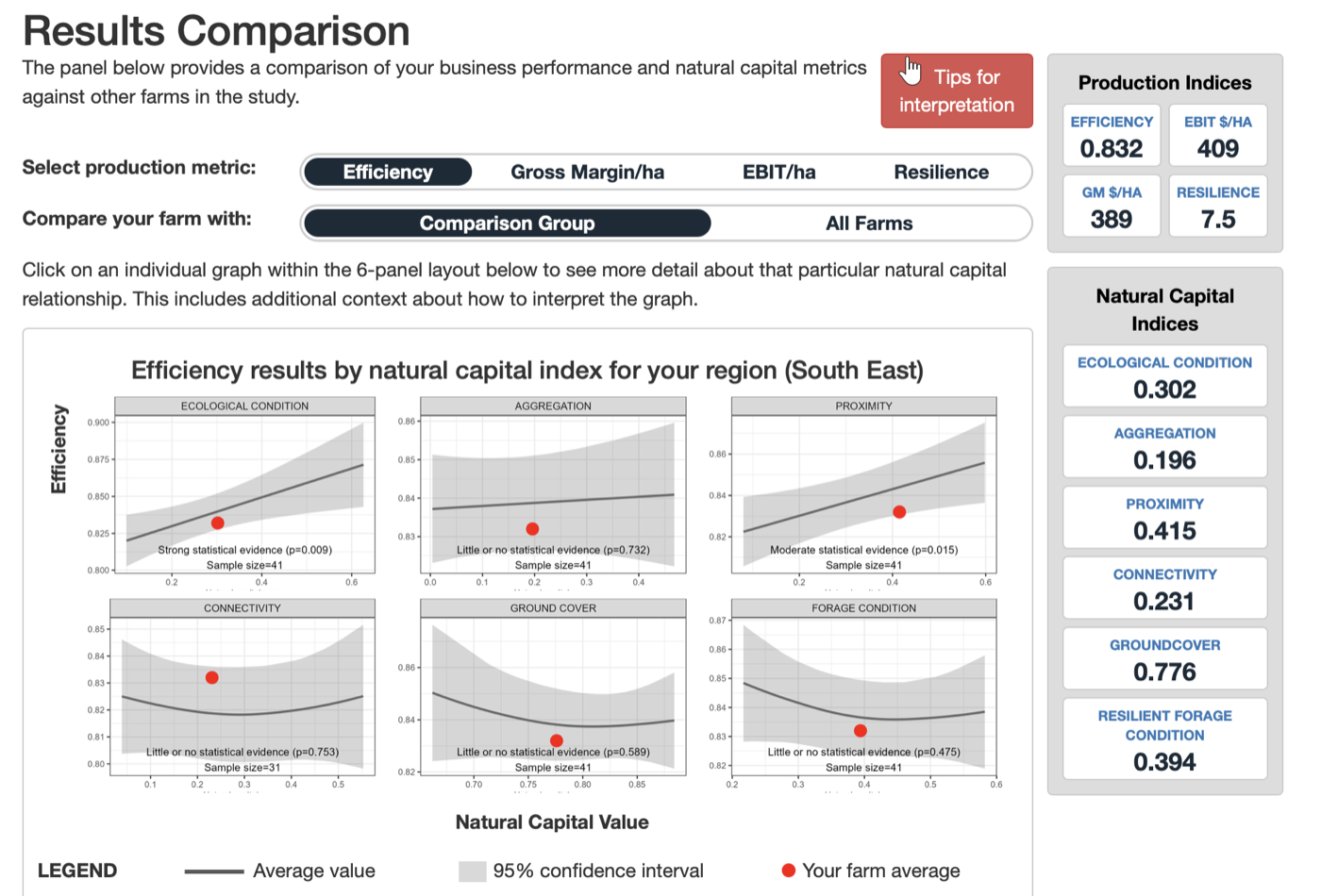
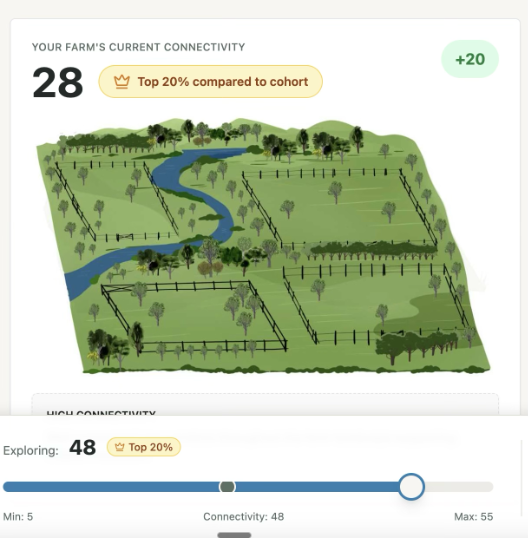
The science was never the problem. What farmers received was dense statistical reporting that took an analyst to read. The prototype put the same underlying data into a form a farmer could act on, and that shift is what moved willingness-to-pay.

The original reporting: a six-panel statistical comparison of efficiency against natural capital indices, with confidence intervals and p-values.
Before: results delivered as statistical comparisons, with p-values and confidence intervals across six panels.
The prototype: a farm map showing connectivity score of 28, marked top 20% compared to cohort, with an interactive slider exploring a score of 48.
After: a single score for the farm, its standing against comparable farms, and a slider to explore what improvement is worth.

Status

Ongoing; scaling model developed, product validated with farmers

In their words

[Our operator] has been even better than I had hoped. He is just deeply and genuinely respectful of our experience and work, and in bringing his very different approach, it's additive. It's showing us a different way of doing things.
Sue Ogilvy, Program Director, Farming for the Future
His work focused on getting the outputs to farmers in a way they responded to. Toby's genius was his ability to nail this and demonstrate demand. He's got such breadth and depth, an absolute gift for this work.
Sue Ogilvy, Program Director, Farming for the Future

A Better Way Forward

Let's put promising solutions to work.

Tell us where your team or portfolio is stuck. We'll give you an honest read on whether there's a fit.